5.7.3. Results
The results of the modeling process show that the adaptation actions for the Population and Health sector yield substantial economic returns, with benefits significantly surpassing costs. As illustrated in Figure 18, the net benefit amounts to US$1,304 million for the period 2025–2050. The most significant benefit comes from improving water quality and access, which alone contributes US$1,305 million, primarily through avoided healthcare costs for water-borne diseases. This is achieved by implementing measures such as the Water Supply Development Strategy for Non-Utility Service Areas, at a cost of US$158 million.
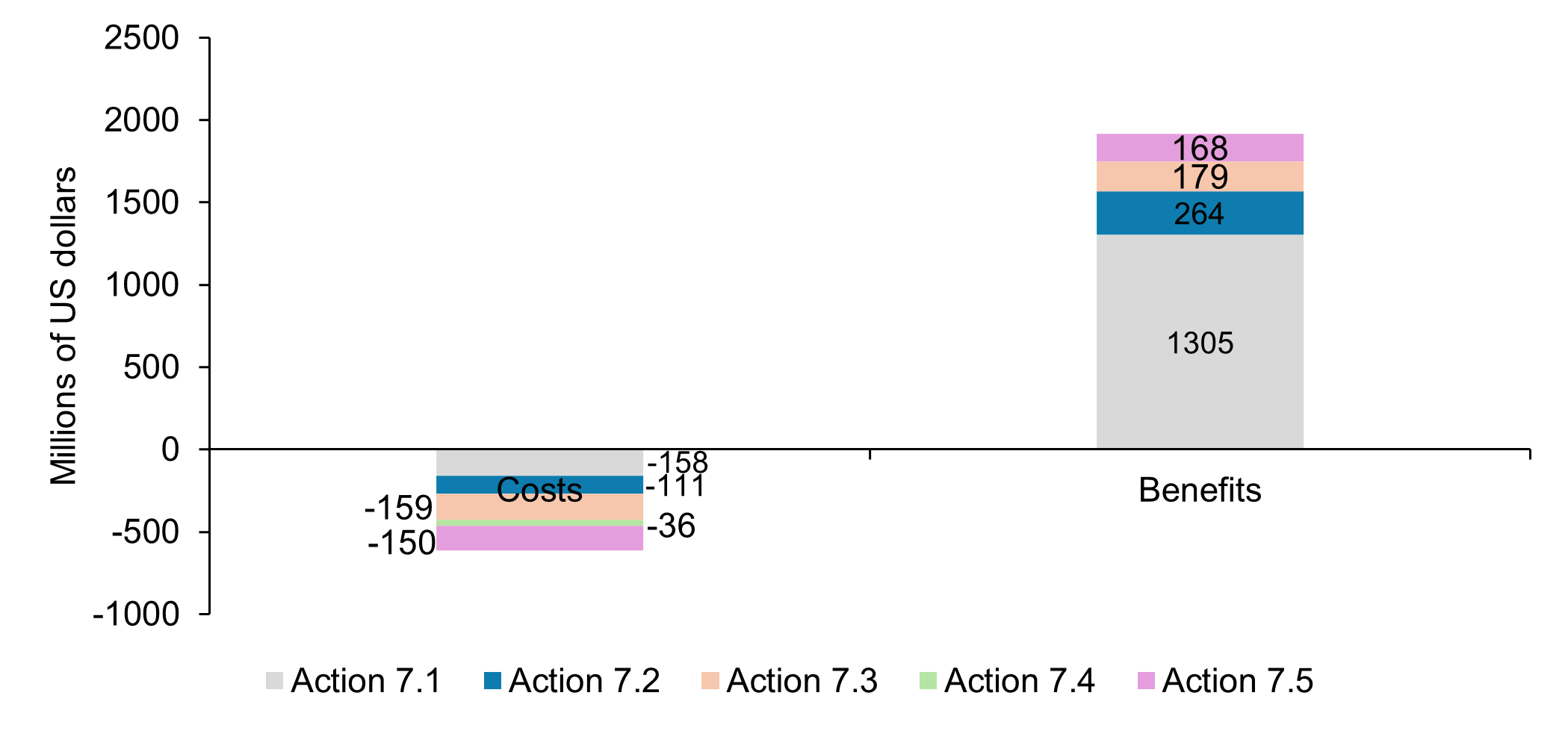
Figure 18: Costs and benefits disaggregated from the modelling process for adaptation actions in the Health sector. (Action 7.1: Improve water quality and sanitation supply. Action 7.2: Improve presence and access to green areas and park areas to improve public health. Action 7.3: Develop a shock-responsive social safety net for post-disaster recovery. Action 7.4: Strengthen vector-borne disease surveillance programs. Action 7.5: Implement the National Financial Inclusion Strategy)